Huntsville, AL · Residential concrete
Concrete in North Alabama lasts or fails on what lies underneath
When a Huntsville driveway cracks or a patio tips toward the house, the concrete is rarely the first thing that went wrong. Red clay that softens in wet months, backfill that keeps sinking beside the foundation, storm runoff with nowhere to go, and limestone ground with a habit of forming sinkholes do most of the damage. Through Twickenham Concrete, a Huntsville-area homeowner reaches a residential concrete contractor who walks the property first, reads the soil, grade and runoff as closely as the slab itself, and only then prices a scope that fits what the lot requires.
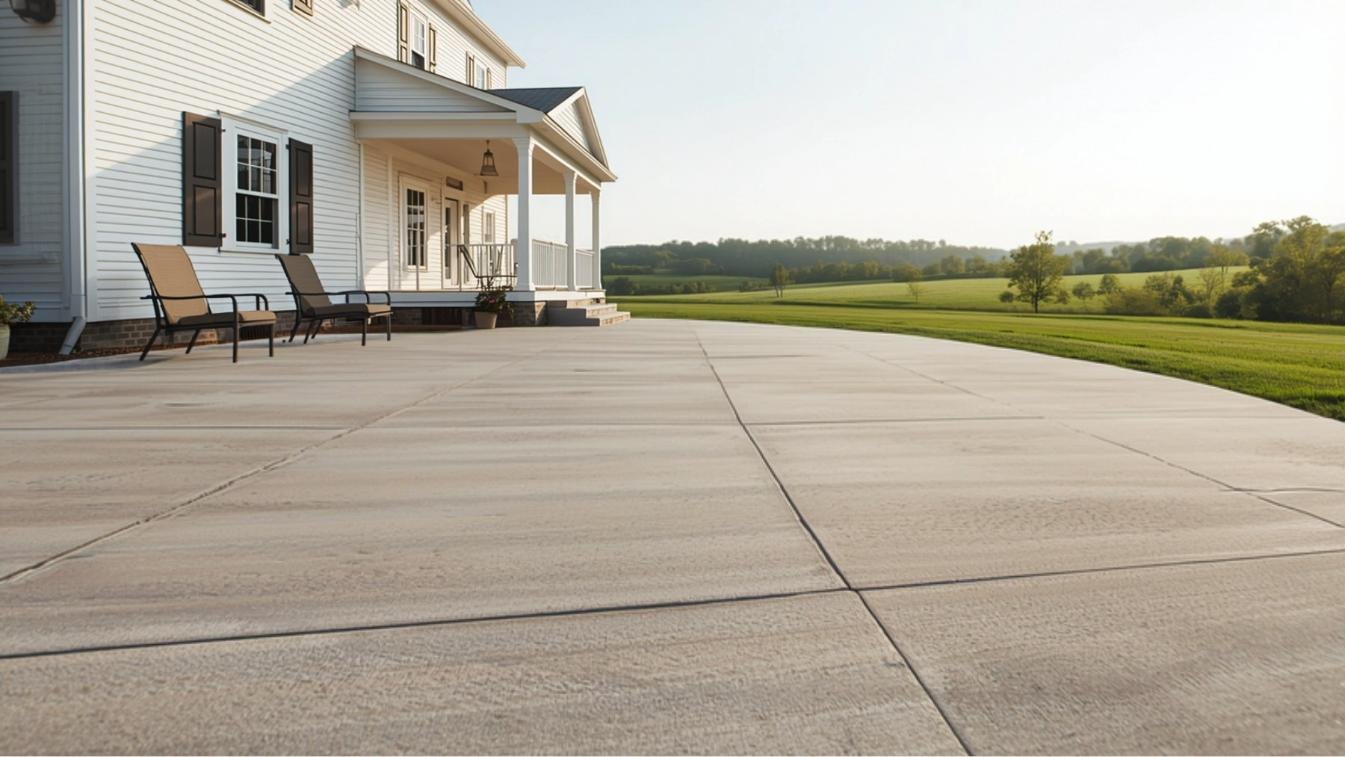
Valley clay, chert slopes and limestone below
Think of a slab as a rigid plate lying on the ground. It handles weight well as long as the ground pushes back evenly everywhere. On the floor of the Tennessee Valley around Huntsville, Madison and Athens, that ground is usually a deep reddish clay or silty clay loam, weathered over ages from the limestone beneath it. When it stays evenly moist, it is a decent place for concrete. When a rainy winter and spring saturate it, it softens. When a dry spell at the end of summer draws the moisture out, it can shrink and pull away from the underside of a slab.
Concrete resists crushing very well and bending very poorly. If one corner of a driveway loses support, every car that rolls over that corner flexes it a little, until a crack forms along the line where the support changes. That is why so many cracks in older driveways here run straight across the slab a few feet out from the garage, or cut a triangle off a patio corner.
On the mountains and ridges east and south of Huntsville, the story shifts. Lots on Monte Sano, Green Mountain and the slopes around Jones Valley and Big Cove often sit on thinner, stonier soil full of chert, with rock close to the surface. Undisturbed hillside ground can be firm, but lots there are often leveled with fill, and water races downhill along the edges of drives and walks.
Beneath much of the region lies limestone, and North Alabama is well known for karst features: sinkholes, springs and caves. Most slabs will never sit over one. Even so, a depression in the yard, a low spot that drains unusually fast, or ground that has sunk over time is worth pointing out to the contractor before a new slab is laid out over it.
Heat, humidity, storms and a few hard freezes
Huntsville summers are long and humid, with frequent afternoon thunderstorms. Heat is hard on freshly placed concrete, because the surface can dry faster than the concrete below it, which weakens the top layer and invites fine surface cracks. That is why summer pours often start early in the morning and why curing, whether with a sprayed compound, wet coverings or both, gets real attention in the warm months.
Spring is storm season across the Tennessee Valley, and heavy rain arrives in bursts that test every slab’s drainage. Water that reaches the clay under a driveway or patio stays there, and repeated soaking carries fine material out from under edges. A slab with a steady slope and a clear exit for runoff sheds that water. A slab that is flat, or tilted toward the house, holds it where it does harm.
Winters are mild by national standards, yet most years bring several hard freezes and the occasional ice storm. Water that has soaked into the surface of concrete expands as it freezes. Repeated cycles can cause the top layer to flake, called scaling. Road crews treat highways with brine and salt ahead of winter weather, and that residue drips off cars onto garage aprons. Air-entrained concrete, a mix with tiny, evenly distributed air bubbles, gives freezing water room to expand and is common for exterior flatwork in climates that freeze. It is a reasonable question to ask for any outdoor pour.
The hidden steps that decide how long a slab lasts
Picture a pair of fresh driveways that match on day one; ten winters on, one is still flat and the other is broken. The difference comes from steps that are buried once the concrete is placed, which is exactly why they belong in the conversation before the pour.
Subgrade and base
Topsoil, roots and soft pockets should be removed, and crushed stone spread in thin layers, each one packed down by machine before the next goes on. On clay ground, that compacted stone layer does more for a slab than nearly any other decision, because it spreads load and lets water drain out from beneath.
Thickness where it counts
Patios and car driveways are commonly around four inches thick. Pads that carry pickups, campers, boat trailers or equipment are often poured thicker, and edges where tires roll on are frequently thickened further. A quote should state the planned thickness and where it changes.
Joints placed on purpose
All concrete shrinks as it cures, so it will crack somewhere. Control joints give it a neat, planned line to crack along. Spacing is usually tied to slab depth, so a thicker slab can have wider panels. The grooves must be deep enough to matter and made early, before the concrete picks its own crack line.
Reinforcement set at the right height
Wire mesh, rebar and fibers each have their uses. None of them prevents cracking. Their job is to keep cracked pieces tight and level. Steel resting flat on the stone under the slab accomplishes little, which is why it helps to ask what will hold it up while the concrete goes in.
Curing and slope
A young slab should hold onto its water while it hardens, and a bright July morning works against that. And the finished surface should always pitch away from the house so runoff heads into the yard or the street, never toward the foundation or across the garage threshold.
Request an estimate visit
Send the property address and a line about the project: a new pour, a replacement, or a slab that has begun to crack or sink. A reply follows to set up a visit.
Talk through your project
Photos of the area from the street and from the house help a contractor read the slope and the drainage before arriving.
Six kinds of residential concrete work
Most home projects fit into a few categories, and many combine several. A driveway replacement often brings a new front walk with it. A patio may need steps down from a deck or a back door. Stamped patterns, color and exposed aggregate can be applied to nearly any of them, each with its own upkeep. Repair and replacement sit apart, because the first question there is whether the existing slab can be saved.
Concrete Driveways
New drives, widenings and tear-outs built on a compacted stone base.
Concrete Patios
Backyard slabs pitched so storm water leaves the foundation alone.
Stamped & Decorative Concrete
Stamped patterns, color and exposed aggregate, plus the sealing they need.
Walkways & Steps
Front walks, side paths and steps with even risers and good grip.
Garage, Shed & RV Slabs
Pads for sheds, shops, garages and campers, sized to the real load.
Concrete Repair & Replacement
Reading the cracks first, then choosing to seal, lift or repour.
Details worth gathering before the estimate
Sharing some basics early trims the first phone conversation and gives the site visit a head start. Nothing here is mandatory, and estimates are welcome.
- The address, and whether an HOA or a historic district reviews exterior changes where you live.
- What you want built or repaired, and about how big it is. Pacing it out is accurate enough.
- What will rest on it: family cars, a work truck, a camper or boat, a hot tub, or only chairs and a grill.
- Anything already on the spot, like a cracked slab, blacktop or a gravel pad, that would need removing.
- Where rainwater runs and collects today, including downspouts that empty near the spot.
- A finish you are considering, such as broom, stamped, colored or exposed aggregate.
- The path a loaded mixer would take to get close, because gates, septic fields and soft lawn all affect access.
If the work reaches the street, such as a new apron or curb cut, ask the city or county which approvals apply, and check with the HOA about its own process. Requirements differ from one place to another, and learning them before the date is set avoids delays.
How a project typically moves from request to pour
After a request comes through, a walk-through gets booked, and the true shape of the job is settled on that walk. Standing on the site shows the soil, the grade, where water runs, how an old slab failed, and how equipment can reach the work. A job that looks simple in a photo may need drainage changes or extra base once someone walks it.
Next the contractor puts an estimate on paper. The helpful kind names the square footage, depth, stone base, steel or fiber, joint plan, surface texture, any demolition and disposal, and the direction water will leave the slab. Line estimates up item by item. When two bids for one yard look far apart, they are often pricing different work.
If you move ahead, the contractor picks a date around the weather. Work slows in cold snaps and long wet stretches, and summer pours are often set for early morning. Once it is placed, foot traffic waits a few days and vehicles wait longer, with exact dates given by the contractor for that pour and that season.
Where requests come from around Huntsville
Most requests come from three counties in the Tennessee Valley. Each mixes older in-town streets, fast-growing subdivisions and rural or lakeside lots, and soil and grade can differ between neighbors, which is why a site visit tells more than any map.
Huntsville concrete questions, answered plainly
What usually makes a Huntsville driveway crack early?
The ground under it, far more often than the concrete. Red clay softens and swells in wet spells and shrinks in dry ones, and the strip of backfill beside a garage keeps settling if it was never compacted in layers. Missing or shallow control joints add random cracks on top. A step in height across a crack is the fastest hint about which cause is at work.
Which months suit a concrete pour in North Alabama?
Spring and fall are the gentlest seasons for fresh concrete, yet pours go ahead in most months here. Summer work tends to start at first light, and the fresh slab is kept moist or coated so the heat cannot pull water out of its surface too soon. In winter the worry is a hard freeze in the first few days, so a cold forecast can move the date. Spring storms also shuffle schedules.
Can a settled slab be lifted rather than torn out?
Often, when the section has sunk but is still one solid piece. Foam or a cement slurry injected through small holes can raise it back toward level, and that suits walks and driveway panels that dropped over loose fill. Lifting suits a slab poorly when it is shattered, deeply scaled, or perched over soil that runoff keeps carrying off. A look in person settles which case you have.
How soon can I walk and park on new concrete?
Foot traffic is usually fine after a few days, while cars should wait noticeably longer because concrete keeps gaining strength for weeks. Trucks, campers and trailers need to wait longer again. Cool weather slows the process, so timing shifts with the season. Ask the contractor for dates that fit your particular pour, and keep sprinklers, pets and delivery vans off the surface until then.
Is sealing worth it on concrete in this climate?
For decorative, colored and stamped surfaces, sealing is standard, because it protects color and slows staining and water absorption. For plain driveways and walks it is a common recommendation rather than a must. North Alabama sees fewer freezes than colder states but still gets a few hard ones, along with brine on roads during winter storms. The contractor can suggest a product and a reapplication schedule.
Will my project need a permit or HOA sign-off?
That depends on the address and on what the work changes. New driveway aprons at the street, altered curb cuts, drainage changes, outbuildings and visible work in historic districts are the usual candidates. Huntsville, Madison, Decatur, Athens and the counties each run their own process, and many subdivisions have an HOA review as well, so check with the right office and the association before a date is set.
Does stamped concrete make sense for a backyard patio here?
It can, if you accept the upkeep that comes with it. A stamped patio gives the look of slate or brick as one continuous slab, with no joints for weeds or ants. In return it needs resealing every few years to hold its color in strong sun, and a glossy sealer turns slippery in the rain unless fine grit is mixed into it. Shaded patios also need occasional cleaning for mildew.
Talk through your project
Send the address, what you want poured or repaired, and a few photos. Shots of cracks, sunken corners and spots where water stands after rain help the contractor most.